The EuroZerozone is in all kinds of trouble now, having staked its whole economy on the ability of the Greeks, Portuguese, Spanish, Italian and Irish to reduce unemployment, public spending and public borrowing under IMF-style conditions.
More ominous still, the US Federal Reserve has had to step in and co-ordinate global central bank co-operation to "prevent the spread of strains to other markets and financial centers." It added that "Central banks will continue to work together closely as needed to address pressures in funding markets."
But as we've seen from the subsequent unabashed self-indulgence amongst bailed-out banks and bankers: the pressure is off once you know that no one will let you fail.
The charts show the vast quantity of government debt issued by Portugal, Ireland (and/or Italy), Greece and Spain (now called the "GIPS", to be politically correct) due to be repaid ("mature") simultaneously.
"So what?" you may ask, if you've been distracted by the UK elections.
The charts also reveal high unemployment, budget deficits and public borrowing. So these countries will struggle to pay investors to extend the due dates ("maturities") on existing loans - “amend and extend” in callous market jargon. Investors will cut their losses and/or refuse to lend at less than credit card rates. Bail-out bodies, like the International Monetary Fund (IMF) will only help if the country concerned can implement 'austerity measures' to cut its deficit and get its economy under control.
The results of suddenly imposing such measures on citizens who hadn't realised how bad things were - or why - can be seen on Greek streets:
In fact, Zero Hedge is tipping "the inevitable disintegration of the eurozone and the upcoming eventual debt payment moratorium." Which means there's a lot more mayhem to come for the European financial system. And even the EuroZerozone" countries with the deepest pockets - like Germany and France - could need to rein-in substantially.
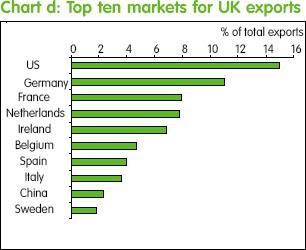
So, if the UK is to reverse its trade deficit, it must find new export markets pretty fast. Here's how Economics Weekly thought 2010 would play out on the export front as at 1 March (i.e. before the Greek bail-out):
Given the speed of deterioration in the Greek scenario during April, the demand from EU countries may well be over-stated. And the debt maturity charts suggest 2011 could be worse.
But commit to it they must: it's a travesty that 23% of the national vote could produce only 9% of the MPs. And it is small consolation to the people who comprise that 23% (not to mention the 29% who voted Labour and the 11.9% dismissed as voting 'other') - that 'their' 57 MPs hold the 'balance of power'.
The general election would have been more engaging and vastly more inclusive if the 63.9% of voters who did not receive their first choice could have nominated the candidate they'd have preferred to win instead. That's what Proportional Representation is all about.
Despite moral panic designed to dodge the issue yet again, electoral reform will not 'distract' anyone from cutting the £163bn public deficit. All are agreed that economic reform will be business as usual for this government. In fact, as a result, it should be 'less busy than usual'. So there'll be plenty of time to work out the move to one style or other of Proportional Representation.
Commitment to electoral reform might even lead the unlucky 63.9% to work much more willingly with the lucky 36.1% to cut the budget deficit.
In many ways the UK general election has not gone the way anyone wanted.
Sure, we have a hung Parliament, 149 MPs from the last scandal-ridden pit did not stand, Jacqui Smith lost her seat, and the BNP didn't get any at all.
So one thing seems assured: this Parliament is in for a bumpy ride.
And this is a great outcome. We have MPs exactly where we want them. They are not in control. They have little alternative but to listen and respond to our issues bottom-up.
Independent forums like Power 2010, 38 Degrees, and TheyWorkForYou, are genuine attempts to gather and share everyone's views without regard for 'party lines'. The politicians would do well to engage with them instead of relying on their own party 'research' to validate policies they want to impose from the top down.
But we too need to participate by sharing our concerns: we'll only get the government we deserve.