Google

Tuesday, 2 August 2022

Who Will Rescue Britain?

When the renowned diplomat, Niccolo Machiavelli, wrote his "Letter to Lorenzo de' Medici" 500 years ago he considered Italy to be "divided...leaderless, lawless, beaten, plundered, broken and overrun, ruined in every way". Thanks to poor government amidst successive crises, Britain now ticks all these boxes. If any Prime Minister since Blair had even read Machiavelli's entreaty, then they can only have done so in order to break every rule in the book; and Johnson's successor is already bound to follow suit. Who will ride to the rescue - and when - is anybody's guess. Yet, like Italy 500 years ago, the time is right. If only the next leader will heed Machiavelli's advice...

The best illustration of how not to become 'World King' (as he infamously fancied himself) has been drawn by Boris Johnson. 

While a man of his education and alleged intellect should have read The Prince, it would not surprise me if it turned out - very ironically - that he claims he has but, in fact, has not. 

If Johnson has read The Prince, then perhaps he believes that, like so many others, those rules don't apply to him...

Machiavelli advocated that a good ruler should strive to appear wholly compassionate, loyal, humane, honest and religious, yet know how to occasionally act otherwise when required. He or she must adapt their chosen strategy or tactics to changes in fortune or 'luck'. A ruler must not seize or steal their subjects' property or women/men; or be seen as "changeable, superficial, effeminate, fearful or indecisive." The ruler's choice of ministers will immediately demonstrate to the country either "good sense or lack of it." Ministers should be intelligent people with permission to tell the ruler the truth, rather than flatterers. The ruler should build a reputation for 'meanness' rather than generosity:

"...if you're determined to have people think of you as generous, you'll have to be lavish in every possible way; naturally, a ruler who follows this policy will soon use up all the wealth to the point that, if wants to keep up his reputation, he'll have to impose special taxes and do everything a ruler can to raise cash. His people will start to hate him and no one will respect him now he has no money... his generosity will have damaged the majority and benefited only a few..."

Above all, "a ruler must avoid any behaviour that will lead to [their] being hated or held in contempt."

Did Johnson follow any of these principles?!

While he began his brief tenure as Prime Minister already flawed in ways that soon became glaringly apparent, Johnson's earlier political moves were at least promising. He rightly spotted that Ken Livingstone's woeful performance as Mayor of London presented a golden opportunity to quite as an MP and seek mayoral office of the nation's capital to garner popular support. He adapted his strategy to luck. Winning a second mayoral term was also key to emphasising that popularity; and breaking his promise not to run as an MP in the next available general election was something that Machiavelli also would have applauded, since he stipulated that there are times when keeping a promise is not important as breaking it in order to survive. 

Yet, we now know that Johnson is incapable of 'being good', let alone generally keeping his promises, or even affecting any of the qualities that Machiavelli advised. His three word slogans were all a cover for doing the opposite.

One need only consider his delay in managing Covid, serial philandering (even during his then wife's illness) and dishonesty over the likely effects of Brexit. 

His choice of advisers, ministers and unwillingness to sack them (too late, if at all) showed a complete lack of good sense. 

His dithering and repeated U-turns showed him to be changeable, superficial, effeminate, fearful and indecisive.

Even while Mayor of London, Johnson had literally been sowing the seeds of his eventual demise by becoming embroiled with Arcuri, allegedly helping himself (again?) to other people's women and money. And even if that were not in fact the case, Machiavelli would say it's the appearance that counts. 

Taking up with Carrie while married, trying to get her a public job, setting up a 'VIP lane' for Covid contracts, appointing cronies to the Lords and grasping at donors' money to refurbish his flat only cemented Johnson's snow-balling reputation for poor judgement and plundering his subjects' money.

Partying during lockdown in violation of his own rules while exhorting others to comply in the most dreadful circumstances was exactly the sort of behaviour that would lead to his being hated and held in contempt.

Indeed, ultimately, Johnson's lavish misuse of public money did in fact use up all the wealth to the point that he had to impose special taxes and do everything he could to raise cash. And his people did start to hate him and lose respect when he had no money, his generosity having damaged the majority and benefited only a few. 

In fact, Johnson's misconduct has amounted to such a gross violation of Machiavellian principles that one wonders if his rise to Prime Minister was not, ironically, the successful application of those very principles by some other head of state... 

But even Putin appears to have lost his touch.


Wednesday, 20 July 2022

The End Of 'CovidBrexidiot' Johnson

Well, finally Johnson has gone, albeit with veiled threats of a comeback ("for now" and "hasta la vista, baby," alluding to Terminator). He was easily the worst Prime Minister in British history, for perpetrating a seemingly endless array of havoc and unlawful conduct that came way too depressingly thick and fast for these pages. So let's hope there's no sequel. 

Yet Johnson's parting reference to the Terminator is quite apt. Like the unstoppable android, Johnson himself morphed from one 'side' to the other and is a character of pure fiction.

Well, almost.

The facts we know do not favour this man, and it is to be hoped that one day he atones for at least some of his misdeeds, as do his ministerial minions. One wonders why Britain bothers having the offence of Misconduct in Public Office if Johnson and his cabinet cronies aren't going to be prosecuted for it.

Maybe one day the full story of Johnson and his Tories' vice will come oozing out, like pus drained from an infected wound. But I won't be joining any hospital queue for that. The events of the past six years has taught us that the British state is both weak in constitution and morbidly corrupt, and there's no institutional longing for a cure.

Even now we're witnessing the unedifying display of the wealthy, old, Tory faithful tossing up between Richy 'the Dork' Sunak and a store mannequin for their new 'leader' as if it even matters whose snout goes into the public trough next, given the parlous state of the kingdom.

With any luck, the next incumbent will also succumb to revelations about their role in the rorts wrought by the Johnson regime, accelerating the next General Election...  

That's not to say that the state of the Disunited Kingdom would necessarily be improved if the so-called 'Opposition' were voted in. But there's at least a natural hygiene effect in changing the party in government at every election, like changing your underwear daily to get rid of any foul accumulations. 

It's probably inappropriate to switch this metaphor to the idea of a 'hung' Parliament, but it's worth doing so to ram home the lesson that nothing good seems to come of allowing either of the major parties to linger for a second term.

At any rate, let's hope for a quick end to Tory government No. 94...


Friday, 23 April 2021

Harness The Power of Dumb: Embrace Your Doom!

Fuck it. You labour night and day, learn your lessons, do your homework, get your tickets, play the game by the rules, then along comes a self-entitled prick like Boris-screw-anything-that-moves-Johnson to sweep it all away. How? By being Dumb. You failed to learn the Power of Dumb.

I'm not talking about the inability to speak, or write, or add up.

I'm talking about Wilful Stupidity. 

I'm talking about knowing the right path and deliberately choosing the wrong one and selling it as the right path.

On a massive scale.

Fraud on a small scale just gets you jail. Hell, the Post Office will even frame you for its own mistakes, and the executives who do that to you will walk away free.

Don't talk to me about Bernie Madoff. He made-off with his investors' money for decades, promising them highly improbable returns and leaving them nothing. Jail was his retirement plan.

Boriskovich 'CovidBrexidiot' Johnson has pulled off the biggest electoral fraud in British history and his victims made him Prime Minister. That's all he wanted. Job done. The endless grifting is just a bonus. A free-for-all for the Dumb Club.

You might console yourself with 'It Won't End Well' etc., but you're just telling yourself what you need to get through the day playing by the rules. Low-lifes like Johnson are off to the races and they don't care a damn.

So, ask yourself: what might people really, really, really want? Dream big. Dream Enormous. A bridge to Ireland over a vast munitions dump has already been taken, as has a new UK sat nav system that probably won't work.

Once you've decided on your goal, ask yourself two sets of questions - hell, you might even write two taking opposite sides:

What would be the Right Way To Get It? The Right Things To Do? The Right Path? The Smart Path?

What would be the Wrong Way To Get It? The Bad Things To Do? The Wrong Path? The Dumb Path?

Choose the Dumb Path.

Get Elected.

Harness the Power of Dumb.

Make everyone else regret it, not you!

Sure, they'll all be angry and some will be desperate for vengeance. 

But that only means you won, right?

Embrace your Doom!


Wednesday, 7 April 2021

A Strange Speech From The Governor

The Governor of the Bank of England has a key leadership role in the UK financial system, so it's important to understand his vision for Britain's new role in the wider world. Hence my interest in his strange speech on the "future of financial services".

In keeping with his political masters' devotion to nostalgic sense of entltlement he harks back to events just after the second world war and a commitment to an 'open world economy'. He points "with pride" to the fact that the Bank of England chairs two of the four main standard setting bodies of the international financial system – the Basel Committee for banks, IOSCO for markets, the IAIS for insurance, and the CPMI for payment and markets infrastructure. It is in this context that he launches a veiled attack on the EU for failing to grant equivalence to regulation in various UK financial sectors, despite the UK leaving the trade bloc. He suggests that Britain does not participate in forming global regulation to water it down, while his political masters intend exactly that. He points, ironically, to the City's "long history" of openness while failing to acknowledge that this was predicated on EU membership, and the protection that afforded London as a home for European financial markets, while only days later Amsterdam's share trading volumes exceeded London's. He whines about lack of equivalence findings from the EU, yet merely promises that "The UK’s financial markets and its financial system are therefore open for trade to all who will abide by our laws and act consistent with our public policy objectives." He then complains about the UK being a 'rule-taker'!

The very simple rejoinder to all this is that Britain is right to acknowledge that it must work with others to change the international rules before it can change its own. But it only has itself to blame for making that task harder by leaving the EU and losing influence over the shape of EU trade rules. 


Sunday, 14 February 2021

Britain's Gaslit Future: So Bright You Gotta Wear Shades

The gaslighting is now so strong in Britain that you can't watch a government press conference without sunglasses. The last six weeks in plague-ridden lockdown have been particularly surreal. There's a horrible grinding sound as if whoever's really driving Britain is struggling to find reverse, while the CovidBrexidiot at the wheel claims that trade in goods is flowing as smoothly as public funds into his Tory cronies' pockets. Buried within the government's sycophantic media are tell-tale signs that ministers and officials never understood the trade barriers that EU membership suspended between Britain and its closest neighbours, let alone their own new rules; and none has read the withdrawal agreement, EU-UK trade deal or the mystical 'Northern Ireland Protocol'. We were even treated to the Parliamentary pantomime of Brexidiot Villiers urging Brexidiot Gove to 'renegotiate' a new protocol to replace the existing one. Fresh from misselling the benefits of the Japan trade deal, Brexidiot Truss has notified Britain's Pacific neighbours of the intention to join their trade pact rather than the world's largest only 21 miles away. Meanwhile, the Right Honourable Wackjob Reclining-Smug has regaled Parliament with claims that local fish are "happy to be British" and his favourite breakfast is "nanny's home made marmalade on toast".

But none of this is really new. A strong sense of denial and unjustified entitlement has powered British politics for well over a century. While most major countries embraced their relative positions in the world, Britain's political cult leaders and their followers drank constantly from a deep well of nostalgia-laced Kool Aid. Scorning the fact that phyrric victories in successive global conflicts had left their country dependent on both American money and a steadily growing European marketplace, they branded this twin dependence as Britain's 'Special Relationship' with the US and begrudging leadership of a grateful post-war Europe. 

Never mind the fact that Britain begged to join the EEC over French objections, then tried to cement its place by transforming the trade bloc into a steadily expanding European Union. Ignore 'big bang' when American financial institutions were encouraged to make London their route for raising and deploying foreign capital. 

The British political establishment consoled itself over such bitter compromises with reality by welcoming the embezzled funds of sundry despots and dictators, transforming a string of colonial-era island dependencies into tax havens and London itself into the money laundering capital of the world. Mayfair grew to entertain both US hedge fund managers and Putin's diaspora, united in their need for disruption and the investment opportunities that brings...

There is no better symbol of this constant struggle with reality than the rise of the mendacious Boris Johnson. It may have taken Trump's flash-in-the-pan for British populism to find its voice among the Tories' rabid Eurosceptics, but it took Johnson's peculiarly fraudulent outlook to spot the opportunity to lead them into the centre of government with perhaps the greatest confidence trick in British history.

Whether it's possible for politicians to continue defying the reality of Britain's decline is unclear. Certainly there is little by way of Parliamentary opposition, as their leader seems incapable of unifying his own party let alone pointing out the fundamental flaws in his country's trade plans.

But that gaslighting will definitely need to go up a notch... 


Wednesday, 3 February 2021

Brexidiot British Gove-ment Begs To Renegotiate Brexit After 33 Days

Well that didn't take long. Amidst the widely predicted damage that Brexit is inflicting on the British economy, Brexidiot Gove has written to his EU counterpart under the misleading title "Next Steps on the Northern Ireland Protocol" to list the many ways in which the British government would now like to renegotiate the terms of Brexit and future trade with the EU generally. Fearful of again running out of time, Gove has also requested a delay of "at least" two years in the erection of the barriers that he knew would arise with the end of Brexit transition, despite rejecting the option of a two year extension last June.

Never mind the fact that Brexit was touted by Brexidiots Johnson and Gove as a way to "Take Back Control" or Johnson's electoral commitment to "Get Brexit Done" with an "oven ready deal".

If those responsible for this fraudulent misadventure are not prosecuted for Misconduct in Public Office there seems little point in having the offence on the statute books.

Meanwhile, however, the visionless Labour 'leader' seems intent on placating the flag-waving nationalists who helped Britain into this mess

He and the Tories ignore the rest of us at their peril...


Friday, 15 January 2021

New Year's Resolution: Find The Opportunities In Idiocracy

Earth's future
Returning to these pages from 2020, I feel like a bewildered time traveler. Earth is gripped by climate change and a deadly pandemic. As the hospitals and morgues overflow, the outgoing US President attempts a coup and Britain destroys its own import/export markets, reducing free meals for children to bits of carrot... 
 
It's like the set up for a movie. I'm thinking Idiocracy 2: Birth. A kind of prequel to the first film, which leapt 500 years straight into the future without really explaining how we got there. How society really began to unravel to the point where people can barely speak anymore and don't even need to leave their armchairs to take a dump during Ow! My Balls on the Violence Channel
 
You may think I'm being negative here, but already I've come up with a movie idea, see?! 
 
Indeed, this chimes perfectly with my New Year's resolution: to only see the opportunities amidst all this carnage. Chill out. Enjoy the ride. Whatever happens. Take it easy.

Just do not read my Twitter account.

Sunday, 29 November 2020

Mis-selling Brexit

The British Parliament has finally had the chance to scrutinise the new UK-Japan trade deal that has been trumpeted for so long by Brexidiot Truss. Unsurprisingly, two committees found that the difference between the new deal and the terms available to the UK under the EU-Japan deal are not as extensive as the Secretary of State for International Trade had claimed. An opposition MP found that the government's own figures show the UK will be worse off than under EU terms.

The House of Commons International Trade Committee, did find some extra items on digital services and data (precedent-setting for future agreements) and financial services (including a ban on the need to store financial data in the host country).

The House of Lords International Agreements Sub-Committee pointed out that "exaggerating the gains ... courts unjustified scepticism about what is a respectable ... agreement". 

UK-Japan deal also depends on a trade agreement between the UK and the EU because, for example, "to secure existing trilateral trade flows between the EU, UK and Japan, the UK and EU would need to extend cumulation to Japan through their own trade agreement". 

The Committees want more effective scrutiny of future free trade agreements that are not based on existing EU arrangements, which are likely to be more controversial. 

Meanwhile, Emily Thornberry revealed the results of Opposition efforts to get to the bottom of the economic value of the UK-Japan deal relative to the UK's terms under the EU- Japan deal:


Saturday, 7 November 2020

Lipstick On A Pig: The Decade

The ten years since the first book rose from this bog blog have certainly demonstrated that bailing out the banks fails to change their behaviour and  'people power' is on the rise. Yet 'success' remains elusive, as does any clear sign of a winner in the war between 'intelligent practice' and 'uninformed, stupid practice'. 52% of Brits voted to leave the world's largest trade bloc, and nearly as many Americans just voted for a toxic Donald Trump as voted against him. Maybe we humans just love putting lipstick on pigs?

The successful 'facilitators' of 2011 have indeed become the 'institutions' of 2020, as the US Congress seeks to break their respective monopolies. And political parties have indeed proved to be more concerned with solving their own problems than those of their voters or society.

Individual narratives have begun to subvert the top-down institutional narrative - reality TV and the social media have catapulted lone footballers and 16 year old environmental activists to stardom, while enabling grifters to earn fortunes as social media 'influencers' and even to assume the highest office in their land.

Innovation has continued apace, and it's nice to see that the UK 'crowdfunding' market of 2020 has grown to a record £6.26bn, while the rest of the European has doubled in the same period to over €6.6bn. And this innovation did not 'kill' any other form of finance, as some feared (or hoped). The new and the old co-exist. Even cheques have not died out, while cryptocurrencies have boomed.

And our defences against disaster indeed weakened to the point where we were not ready for myriad floods, fires, global warming or the latest pandemic and its accompanying economic depression.

Financial regulation has flexed belatedly to address crowdfunding and more recently cryptoassets, but continues to lag too far behind ever more rapid developments and to protect regulated institutions at customers' expense.

On balance, greed and stupidity are still winning. Scepticism is applied just as often to hard facts as it is to political delusions or financial scams. Snake-oil vendors have done a roaring trade.

The working title of the next book evolved from "The Personal State" to "You: the war for control of your data and the money that flows from it." The abuse of personal data and artificial intelligence (not to mention encrypted messaging and distributed ledger technology) felt like the source of more bubble-and-crash. But that project stalled in 2015 due to workload and for some reason I lost all appetite for it in 2016... Most posts since then have examined developments in the Brexit farce, the bulk of which inspire nothing more than sarcastic dismissal on Twitter rather than anything approaching thoughtful examination. 

Sad.

It turns out that the direct action of 'people power' merely results in culture wars - including those of the armed variety. We humans just love putting lipstick on pigs...


Thursday, 8 October 2020

A European View of Brexit: Three Sources of Opportunities

Ironically, I was asked to give a European view of Brexit for an online conference this morning. I say, ironically, because it was in my role as an Irish lawyer for an Irish law firm, yet speaking from London as someone who's also qualified as an English solicitor and who left Sydney in 1994 as a 29 year old barrister. I guess that makes me one of Theresa May’s ‘citizens of nowhere’. At any rate, here's a summary of my view - which I tried to couch in terms of opportunities from a European standpoint.

How to view Brexit

I see Brexit as a set of international sanctions self-imposed by voters for emotional reasons - whether perceived 'lack of sovereignty', feeling 'left behind by globalisation', xenophobia or nostalgia. The hard facts never mattered. Trading rights to fish in UK waters to EU countries may have 'sent a shudder' through the House of Commons from a symbolic, nationalistic standpoint but fishing is the UK's smallest industry, employing 24,000 people and exporting 80% of its catch to the EU to help feed 400m people, as opposed to the UK's 65m.

And the hard reality is that the UK helped build the EU trade bloc, including advocating its expansion to 28 members; and contributing significantly to many of its rules, like EU financial services regulation and, ironically, anti-money laundering regulation. So I have little sympathy with the idea that Britain could legitimately expect the EU suddenly to change how it does deals with third countries just because Britain used to be a member state.

Opportunities?

Brexit may be a mess of the UK's own making, but every mess provides an opportunity for someone to clean up.

Looking for opportunities in this context is a bit like the final scene in "The Life of Brian". A lot of terrible things happen in that scene, including mass-suicide out of 'solidarity' with the poor unfortunates being crucified. But it's important to remember that the scene ends with everyone singing “Always look on the bright side of life”.  

To continue the idea that Brexit is a set of self-imposed sanctions, the opportunities really boil down to 'sanction-busting' – finding workarounds for the many problems Brexit creates. Aside from the potential for speculators and other 'disaster capitalists' to make money, there are three sources for these opportunities:

Any form of Brexit means ‘no deal’ for services

The end of Brexit transition period in December means the end of free movement of services from the UK into the EU (and the free movement of the labour needed to deliver them), as well as the end of mutual recognition of professional qualifications, licences and various types of certificates (e.g. veterinary, eIDAS identity certificates and so on).

That's a significant problem because services account for 80% of the UK economy, 80% of UK jobs and a third of UK exports, 40% of which go to EEA countries. 

This means UK firms need to set up EEA hubs, which will bring know-how, jobs and tax revenues to their new home countries. Ireland has a great opportunity here, being the only principally English speaking, common law country left in the EEA with a visa-free Common Travel Area for British and Irish workers. That's why I got my own practising certificate in Ireland and added a consultancy with an Irish law firm, since my UK practising certificate and legal qualifications won't be recognised in the EU after Brexit transition ends.

The perceived mishandling of Covid19 by the UK government compared to others (not to mention a trend toward xenophobic policy measures and right wing culture) might also feed into people’s sense of where is best to live, as could a trend toward remote-working as opposed to treating cities like London as essential hubs.

Britain is a consultant/client state:

Successive British governments have been relaxed about the sale of British businesses to foreign buyers, to the point where there aren’t really many major British-owned businesses anymore, and there seem likely be even fewer in future. 

In fact, Britain has evolved not only into an 80% service economy but also a consultant state - a sort of UK Consulting PLC. It majors in financial services, international dispute resolution, artificial intelligence, computing, construction, engineering and lots of other services (not to mention tax avoidance and money laundering) without actually owning the factories, output, buildings or in many cases even the land on which they're built. 

At the same time the British government apparently sees the job of serving its own citizens as something to be outsourced to private service providers. So the government operates like a procurement platform, paying service providers vast sums of tax money to deliver public services in remarkably autonomous fashion, while extracting taxes from the service providers' public sector income (as a kind of referral commission), as well as the taxes on the revenue from UK Consulting PLC. 

Needless to say, there are all sorts of opportunities for EU/UK service providers to import and export services using local UK/EU entities and locally qualified personnel, subject to dual qualifications and nationality/visas for those who need to move between.

Friction at the borders

There will be problems and delays at the UK borders, regardless of any deal or no deal. So Ireland, for example, is busy figuring out how to get its goods in and out by increased ferry services to and from the EU, and is planning how to open up markets beyond the UK

On both sides of the borders, customers who import from the EU into the UK or vice versa want to avoid 'customs risk'. That means the exporting suppliers must have a local entity/office in the EU/UK that takes on the responsibility and the liability for ensuring goods are delivered to importers. 

In each case, both European and British businesses can assist each other in embracing these challenges as opportunities, even if the ultimate result is a transfer of British business activity to the EU and a British economy that is smaller and produces less than if Britain had remained a member of the trade bloc.

You see, I told you there'd be opportunities!


Sunday, 27 September 2020

One Chart The Brexidiots Never Show Leave Voters

These are not asylum seekers or refugees. This is Tory-approved immigration

Source: Office of National Statistics

Friday, 4 September 2020

Brexit Threat to Consumer Protection For EU Purchases

After years of Brexit delay, suddenly every day brings news of another important detail missed. This one hits consumers just as directly as delays to goods at the border, and depends on the British government understanding the problem and agreeing a solution within the next 119 days...

Currently, if you have a problem with something you bought in EU country, Iceland or Norway you can get free advice from the UK European Consumer Centre. They'll explain your rights as a consumer, help you settle the dispute or put you in touch with someone else who can help.

In May 2020, for example, the centre saw a surge in consumer queries over Ryanair's mass cancellation of flights, and it received 7,067 queries during the COVID-19 lockdown from 23 March to mid-August. Hundreds of thousands of UK residents have been helped during the past 13 years.

The centre is the only service of its type available to UK consumers. It employs 11 specialist staff based at the Chartered Trading Standards Institute in Basildon, Essex, and is jointly funded by the UK and EU as part of a wider ECC network in the countries it covers.

Andy Allen, Service Director at the UK ECC, says that if an agreement is not reached "...this is not a tap that can be turned back on again at a moment's notice – these are specialist jobs. The UK ECC could face closure, the 11 staff could lose their livelihoods and thousands of UK consumers would have no-one to help them in their disputes with traders in the EU."

Let's hope negotiators can find a way to maintain this critical service...


Tuesday, 9 June 2020

COVID19 Reveals A Naked British Government

Cartoon by Peter Brookes
You only learn when things go wrong, as my first boss used to say, and COVID19 is giving the British a masterclass. The pandemic has revealed not only that their government failed them in very practical ways through incompetence, but that it has also unwittingly abandoned many of its core capabilities. A government with an 80 seat majority in Parliament is actually powerless. The British Prime Minister has no clothes.

This is not about small or big government, centralised planning versus devolved powers or libertarianism versus socialism. All models of government must deliver at the basic level that a pandemic requires. Yet since 2015, three Tory governments have failed to ensure that Britain maintained stockpiles of necessary equipment and adequate hospital capacity or was capable of delivering food and necessary equipment to where it's needed. It's not as if the "Opposition" were any more capable of stepping into the breach. Military planners had to be called upon to co-ordinate the response, and their troops to deliver it while ministers remained unable to communicate about the impact and response in a way that built trust in the government's ability to handle this crisis - or the next...  Brexit transition will end without a deal in December, amid far lower investment than in other 'G7' nations; foodbanks abound while crops rot in the fields, and both unemployment and borrowing are beginning to rocket.

Who's managing Britain's state of readiness?

Maintaining a state of readiness for a pandemic or epidemic is obviously critical to fighting it. But that's a process that has to be managed. Stockpiles of food and equipment pass their use-by dates and must be replaced and replenished. Contracts for services and personnel must be renewed to support logistics and distribution. Households need their own stockpiles and workers must be ready to work from home or remotely at short notice. Emergency cash subsidies have to reach bank accounts promptly.

Repeated assurances by the British government that the UK health and social care system was "well-equipped" and "well-prepared" for a pandemic were clearly wrong, just as they have been concerning preparations for Brexit and for recent floodsChannel 4 News uncovered evidence of systemic failure to monitor and maintain stockpiles of PPE and respirators. Almost 80% of respirators in the national pandemic stockpile were out of date when coronavirus hit the UK, and 45% of PPE boxes held out of date equipment. There were no protective gowns, despite recommendations to buy them last year.  Emergency funding has been slow to arrive, and largely involves loans through banks for which government guarantees had to be extended to 100% as they are unlikely to be repaid, suggesting little planning for such an event.

But who, if not the government, manages the process of remaining ready for a pandemic, even if the actual work is outsourced to the private sector?

Responsiblity for the pandemic stockpile and distribution process may have been delegated to Public Health England and a public sector management company, Supply Chain Coordination Limited, but accountability lies with the British government, just as the banks have insisted on its financial backing over the distribution of funding.

Managing the Response

The British government actually wound down its dedicated pandemic response management capabilities over the past four years. In its defence, it might say that it had merely 'streamlined' its ability to deal with all types of catastrophe, and that reflects a trend:
"Without that overbearing [nuclear] threat, much of the planning and preparedness that was set up by 20th Century governments has either fallen away or been subsumed into other crisis management plans. Schemes for how to deal with severe flooding, terrorist attacks or other events that may displace large numbers of people have likely drawn on the old Cold War planning..." How Prepared Are We For A Nuclear War? BBC Future 22. 07.2017
Terrorist attacks have luckily been very localised, enabling prompt containment. Yet, time and again the British government has responded poorly to larger scale floods. Similarly, the supply and distribution of intensive care machines, PPE and testing/tracing capability are large scale challenges this government has failed to meet, even declining involvement in international procurement exercises and offers from local producers, only to later 'beg' for ventilators and protective equipment. Panorama revealed hidden mistakes in actually delivering PPE to health and social care workers, not to mention delays in testing.

As a result, what should be reliable delivery forecasts have become merely arbitrary, aspirational 'challenges' with no certainty as to whether they can be met, let alone sustained.

Increasingly, Johnson's government has fallen back on the British Army's command and control structure to directly manage situations that the government itself should be managing. He has had to rely on the British Army to deliver PPE and testing logistics (as well as construction of makeshift hospitals to cope with anticipated demand for intensive care beds). This reliance, together with the vast number of excess deaths, illuminates the gaps between assurances and reality.

It cannot be acceptable for any government to have lost effective oversight of the process for delivering essential items in a crisis.

Trusted Communications?

There is a huge amount of literature on the importance of trustworthy leadership in a crisis. After all, it is only human to look for guidance on what's happening, what to do and what to expect amidst a major disaster. Without it, humans simply do as they please, with disastrous effects - as the 1918 influenza pandemic showed, even in small rural communities.

Trust is a function of credibilty, which itself is built on honesty and transparency.

Boris Johnson has never been on even terms with the truth and he and his various substitutes at the daily British government press briefings have continually demonstrated a lack of honesty and transparency over every element of COVID19 preparedness and response.

This has provoked both anger at the false assurances, and many media investigations into the true position, including those mentioned earlier. Yet Johnson's government continues its boycott of certain media outlets and ministers have even resorted to muting journalists who ask probing questions during the controlled coronavirus media briefings.

Johnson's latest target for tests was dismissed out of hand, and his confused messaging over whether lockdown measures might be eased produced directly conflicting headlines from two national newspapers in the same stable within a day of each other. There have been U-turns over so-called "plans" to re-open schools as well as car-sharing and likely the belated insistence that those arriving in the UK must self-isolate for 14 days. A major financial stimulus package has been deferred to the autumn. The abominal failure to discipline, let alone sack, Johnson's political adviser over his lockdown adventures is now the stuff of legend.

In these circumstances it is no surprise that Johnson and his health minister score low on trust over COVID19, and the majority of people tend to rely on others for the facts:
Fewer than two in five (36%) said they trusted what the prime minister, Boris Johnson, said on the subject, while just 37% trusted the information given by the health secretary, Matt Hancock.
However, 59% said they placed their faith in the chief medical adviser to the UK government, Chris Whitty, and 55% said they would trust the director general of the World Health Organization, Dr Tedros Adhanom Ghebreyesus.
It remains to be seen how generalised this lack of trust might become, but Johnson's own approval rating has plummeted.

This is encouraging. Any society must consider both the systemic errors and their concealment to be unacceptable if it wishes to protect itself against disaster as well as it can. Whether Starmer is any more likely to get a grip on the situation remains to be seen.

In the meantime, Johnson's Brexidiot government must put some clothes on, even if only to spare us the sight of them...


Sunday, 7 June 2020

Little England Learns Its Place In The World

As the deadline looms for any extension to Britain's transition to lonely outcast in 2021, it is only fitting that Boris "Brexidiot" Johnson should seal that fate by following through on his promise to renege on the UK's Withdrawal Agreement which he only just won an election by promising to sign. No doubt Johnson is fully aware that the Little English have long been infamous in Europe for such acts of duplicity, which was the hallmark of his own stint there as an unreliable journalist. Indeed, the Lyin' King has shown the same duplicity in the course of trade talks with the US. He really is Little England personified.

Duplicitous England has never really been accepted as part of Europe, other than by accident of equally duplicitous geography: a mere 34 kilometres has prevented the frequency of invasions suffered by contintental nations, as has its meagre size and supply of natural resources. After the ignominy of losing the parts of France from which the Normans had successfully invaded, Little England has only thrived as part of a pirate state, from Queen Elizabeth to Queen Elizabeth, enriched only by what it could steal or leech from others by boat and financial alchemy. Even the decision to join the EEC was motivated by greed and envy, rather than any great desire to lead:
Britain joined what was then the European Economic Community in 1973 as the sick man of Europe. By the late 1960s, France, West Germany and Italy — the three founder members closest in size to the UK — produced more per person than it did and the gap grew larger every year. Between 1958, when the EEC was set up, and Britain’s entry in 1973, gross domestic product per head rose 95 per cent in these three countries compared with only 50 per cent in Britain.
After becoming an EEC member, Britain slowly began to catch up. Gross domestic product per person has grown faster than Italy, Germany and France in the more than 40 years since. By 2013, Britain became more prosperous than the average of the three other large European economies for the first time since 1965.
But that status, too, slipped from Little England's grasp, even before the impact of Johnson's appalling mismanagement of the response to the COVID19 pandemic. Since the chart below was compiled, estimates are that Britain will be saddled with more debt than after World War II (which it only finally repaid on 31 December 2006), its citizens no longer able to live, work and trade freely in the world's largest trade bloc amid soaring unemployment.


Source: Institute for Fiscal Studies

There have been endless warnings of Little England's impending, impoverished isolation. Like the Brexit warnings dismissed as "Project Fear", all have gone unheeded, and an Empire on which the sun never set has dwindled to a fractious gang of dependent 'Home Nations' squabbling over their share of the shrinking public purse. 

It's taken ten years for the "Tory faithful" to make the nostalgic fantasy-lined coffin in which their Little England will be lowered to its final resting place.

The end of Brexit transition is the lid.


Wednesday, 27 May 2020

If Cummings Goes, The Lies Expose

Source: BoingBoing.net

It's because Boris Johnson and his merry band of CovidBrexidiots do not share your reality. They live in a tiny model bus that Johnson made out of lies (see clip below). To be allowed to stay in Johnson's bus, the CovidBrexidiots must keep lying. This strengthens the bus, which would otherwise be crushed by Reality, exposing all the lies. 

Dominic Cummings supplies the lies, and targets them at selected believers through a network of social media accounts. Without Cummings the CovidBrexidiots would have no lies, their little model bus would be crushed and all the lies would come out.

Monday, 27 April 2020

Just As Blair Never Escaped Iraq, Johnson Will Never Escape Brexit Or COVID19

There's a lot of speculation about whether Boris Johnson can steady his government's COVID19 plague ship in time to weather the Brexit storm. It seems unlikely, but who knows? What is certain is that the stigma of both disasters will stick to Johnson forever, in the same way the second Gulf War dogs Tony Bliar Blair to this day...

In 1997, Blair found a way to unite Britain by promising a lot: Change, an end to Thatcherism, a new personal empowerment, an "end to boom-and-bust"... you name it. The hype inspired hope on a grand scale, and for his first term it seemed to hold. He was re-elected easily in 2001. Successful peace-keeping efforts in the late 90's led to early wins in Afghanistan after 9/11.

Then Blair succumbed to a Messiah Complex and hope turned to disillusionment. In 2003, he sealed his ultimate fate by ignoring Britain's largest ever mass demonstration and 139 of his own MPs in favour of 10 Downing Street's own "intelligence" to commit Britain to the invasion of Iraq. Oh, sure, Blair also systematically ignored the House of Commons and dedicated himself to dealing with the public directly through media manipulation and spin. He tolerated the Mandelson scandals and the dysfunctional relationship with Gordon Brown, allowing gross over-spending in boom times that ultimately left Britain grimly exposed to the financial crisis. But Blair still won the 2005 election, and enjoyed 2 more years as PM before resigning in favour of the hapless Brown. Yet the invasion of Iraq still hung round his neck:
"In his [May 2007 resignation speech]... Mr Blair dealt directly with Iraq, many people's perception as his ultimate legacy, saying: "The blowback since ... has been fierce, unrelenting and costly."
And even after the intervening financial crisis and the fact that RBS remains publicly owned to this day, Blair's destiny is to be remembered for his role in the invasion of Iraq - as borne out by the reactions that greeted the Chilcot Report in 2016, his interventions during the Brexit debate and the scorn within the Labour Party for his advice in more recent times.

“It is not in the stars to hold our destiny but in ourselves.” 
William Shakespeare

In similar fashion to Blair's Iraq adventure, Boris Johnson sealed his own fate when he threw his political weight behind the infamously dishonest Leave campaign in 2016 (cunningly preferring his own article in favour of leaving to his own article in favour of remaining).

This exemplified the stunning degree of misjudgement for which Johnson has long been renowned

The referendum itself had been mired in controversy even before Cameron promised it as a bribe to right wing Tories to garner their support for his own re-election campaign in 2015. That intensified when he unexpectedly won a Tory majority and was forced by his own party to hold the EU vote. A statesman would have left the matter to the populace and balanced their 'advice' with rational expertise, leaving Britain's unique and beneficial international trade terms in tact. Yet, bizarrely, Cameron committed to implementing the result of the advisory referendum, then lashed himself to the mast, albeit by leading the campaign for the only sustainable outcome. He lost no time in resigning as soon as it was over, and Theresa May's dreadful, already forgotten premiership demonstrated why. The lunatics had taken over the asylum. 

Chief among the lunatics was Johnson, who lurked in the wings throughout the May debacle because his shamelessly opportunistic, narcissistic decision to lead the Leave vote had shackled him to Brexit for the rest of his life. He'd made sure that securing Brexit was his only chance of being Prime Minister, and it remained Brexit or bust for him - no matter that it's Brexit and bust for Britain. Johnson simply didn't - and doesn't - care. It's all about him and his Brexit. He's taken Blair's lack of respect for Parliament to literally unconstitutional lengths. He's ignored bigger demonstrations than those against the Iraq war. He prefers outright lies to mere spin or media manipulation. He ignores detail and prefers waxing lyrical with obtuse references to ancient myths, always myths....

Being remembered for the myth of Brexit is Johnson's destiny.

Then along came COVID19...

Brexit reality has been slow to dawn, mainly because it involves simply not doing stuff.  We've seen the steady departure of EU citizens, headquarters of EU organisations, manufacturing capacity and jobs - all signs of air leaking out of the economy. Meanwhile, essential investment has withered, compared to investment in the other "G7" nations, and successive Tory governments have under-invested in the capability of the British state to actually do the tedious things that Brexit demands, like setting up customs checks and checkpoints, creating the new import/export forms, issuing guidance to businesses and so on. Yet none of that chaos will really hit until the Brexit transition period expires - currently still on schedule for 31 December 2020...

Instead, it's fallen to the COVID19 pandemic to reveal how badly the Brexidiot Tories have under-invested in the British state more generally, and how poorly equipped Johnson and his cronies are to manage Britain's return to phyiscal and economic health. No sooner had the ink dried on the Withdrawal Agreement and Johnson's weird victory speech had echoed through the Old Naval College at Greenwhich than the virus began relentlessly punching him and his Brexidiot crew in the face, remorselessly exposing their lies, misinformation and gaslighting on their state of preparation and ability to respond.  BoJo's Brexit Britain was revealed to be unprepared, ill-equipped, slow to respond, unable to organise delivery of the right protective equipment to staff who need it, unable to arrange testing on the necessary scale and is now second to the United States in the number of COVID19 deaths.

Throughout this lastest crisis, Johnson himself has largely disappeared. Yet amidst his 2 week personal holiday in February and 4 weeks off with COVID19 in April, Johnson's Brexit crew insisted they were working toward the end of transition on 31 December 2020, leaving the EU's chief negotiator to reveal on April 24th that, in fact, the UK "has failed to engage substantially" in the Brexit trade talks at all.

There's no escaping that Brexit destiny, even while he's chiselling "COVID19" onto his tombstone.

Not that Johnson even really cares.


Monday, 30 March 2020

Are We Clear On COVID 19, Boris?

It's difficult to believe that Boris Johnson's first press conference on the COVID 19 pandemic occurred only two weeks ago, on 16 March 2020. Scandalous, in fact, given the need for the government to inspire trust and confidence in its handling of a situation that was already 10 weeks old, so that we all follow public health instructions. Worse, however, is that these briefings are largely used as Johnson's opportunity to lie and misinform. Even Alistair Campbell, the original Spinmeister, finally snapped and provided 20 top-tips for properly keeping the nation informed - advice that's been reported so widely and with such approval that nobody can be in any doubt that Johnson is determined not to be honest at all...

A key feature of this daily 'dog and pony show' is for Johnson, or another Brexidiot minister standing-in, to be flanked by two human shields: either another Brexidiot minister or a senior civil servant to his right; and a senior civil servant to his left. 

When in the middle himself, Johnson largely plays the role of panel chairman, ostentatiously ticking some list of journalists or media outlets, scribbling a note and assigning each question to one of his shields. Though occasionally he fails to resist the temptation to answer with his own waffle or muddle the issue that he's handing off. 

The questions are invited in twos and threes. This also helps shift attention to the 'business' of who will answer each question, rather than the meaning and importance of each question itself. Amidst the confusion it's impracticable for anyone to point out that a question wasn't answered clearly, or at all. 

Questions on the politics get smothered in nonsense or ignored in the usual way, but inevitably it oozes out that a lie has been told or a horrendous error of judgement was made and covered up.

Technical questions - on 'models', the 'science' or health - go to the civil servants, often with a muddle of words from Johnson which the poor unfortunate technocrat has to clear up before getting a chance to answer the actual question.

I pity the civil servants. Understandably, they were not chosen for their jobs based on either their ability to handle a national press conference accompanied by a mendacious narcissist, or to speak in sentences and language that a national audience with a reading age of 11 could understand. So putting them on display like this is Johnson's idea of a practical joke. It would be amusing if this were a televsion show, as one day it might be (Yes Minister with a daily press conference). But now, not so much. 

My personal favourite is the current Deputy Chief Medical Officer for England, and I leave you with perhaps the longest single sentence to date, at nearly two full minutes, on how long the current 'suppression measures' might be in place. This is the sort of question that should've been averted by providing the information succintly in the first place, but the poor DCMO is left to deal with it. Bless her, she deserves a medal for fronting BoJo's despicable regime in a time of great crisis. In the meantime, a nation waits patiently for genuinely informative briefings from the British government...


Friday, 27 March 2020

Stocks May Plunge As Well As Fall. But In The Long Run...?

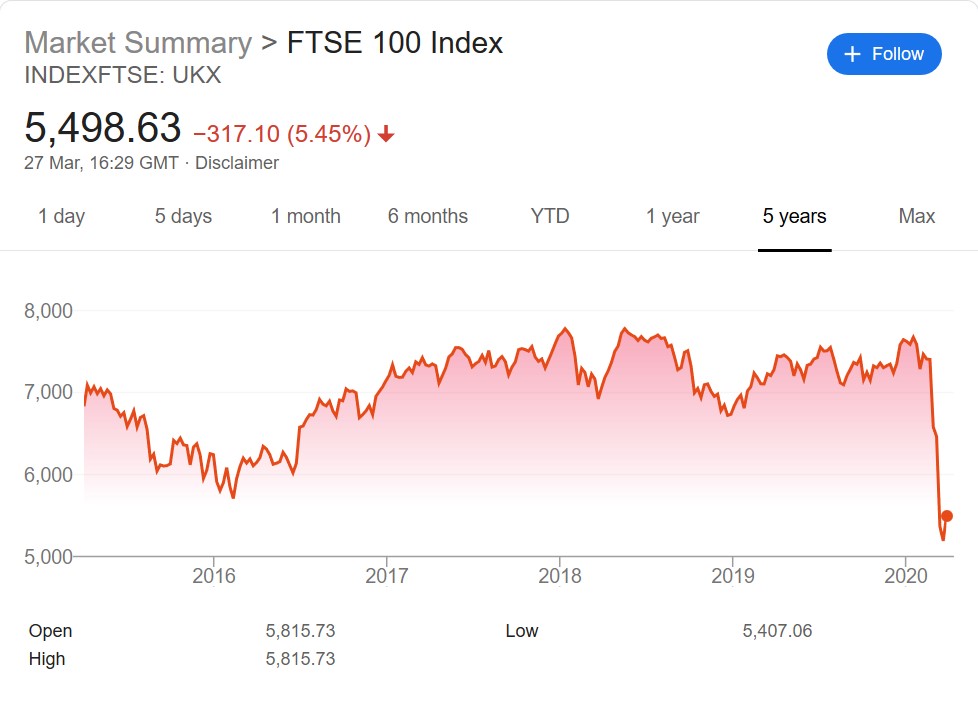
Here's an insight into why investing in the stock market is worthwhile in the long term, and you need to be a professional to pick the highs and lows in any given time frame (with thanks to Google Finance and COVID 19):

1 day chart:


5 day chart:


1 year chart:


5 year chart:


30+ year chart:


Wednesday, 18 March 2020

Get Ready For... 18 Months Of On/Off Supression Measures

Source: Imperial College Covid-19 Response Team
This is the Imperial College COVID 19 report that forced the British government to switch from its reliance on 'mitigation' measures and potential "herd immunity" to 'suppression' measures favoured by most other countries on Earth to avoid their healthcare systems being crushed by sheer numbers of victims being admitted to hospital and/or intensive care units (ICU). 

The report was probably adopted by the Tories merely because it carried the word "Imperial" but, hey, at least it had the desired outcome.

The report explains that suppression measures (isolation for those sick or vulnerable; social distancing; a ban on mass gatherings; and closure of schools/universities) will need to last 18 months, but could be switched on and off during that time to prevent the second and third 'waves' that we saw from the 1918-19 influenza pandemic.

Only the major social distancing and school closures would be 'triggered' with the other suppression measures remaining in place.

The two major suppression measures could be switched “off” when only 50 people in a week are admitted to ICU with COVID 19, then switched on again if 100 people in a week are admitted to ICU; “off” again when only 50 people in a week are admitted to ICU; and so on...

It is estimated that social distancing and school closures would apply in 12 of the 18 months (see above chart).

The report considers it is reasonable to assume that after 18 months we should have a vaccine that has been given to enough people for the suppression measures to be switched off completely.

What this will mean in economic and social terms is anyone's guess, but Brexit seems unlikely to be achievable until it's over, since government, businesses and citizens will not be in a position to understand Brexit impact, let alone deal with it. 


Related Posts with Thumbnails